Climate, Democracy, Dialogue: A Large Bet on a Long Future
We seek financial support to launch The Liberty Hyde Bailey Center in Ithaca, New York, a new kind of public nonprofit institution, which will do the following:
Address the interlinked crises of climate change and civic unravelling together, organizing and supporting multisector actions on issues that are especially urgent for rural communities.
Bridge rural-urban, red-blue, and other polarizing divides through initiatives and programs that are co-developed with partners, working alongside local community leaders and organizations.
Awaken and tap people’s civic talents, creativity, and imagination, using diverse interdisciplinary methods to advance the critical work of building relationships and trust to counter the corrosive polarization that stymies progress on issues of climate and inequality.
We propose to launch this work with a statewide, five-year Rural-Urban Dialogue Initiative, in close collaboration with our invited partners in Cornell University’s Ashley School for Global Development and the Environment and the Brooks School of Public Policy, in the State Legislature, in Cornell Cooperative Extension (CCE), and among independent rural organizations. Guiding discussion toward strategic action, these dialogues will 1) identify a set of common problems facing rural and urban New Yorkers and help set the direction for future collaborative work between the Center and its partners; 2) surface leaders embedded in communities across the state who will help to push work on these issues forward in the future; 3) help to build a social infrastructure for ongoing dialogue and coalition-building between rural and urban that addresses and reduces political polarization and gridlock.
The work of the Liberty Hyde Bailey Center will flow from and draw on the substantial body of Bailey’s own writings and work on rural culture and ecology. Responding to the democratic crisis of the Gilded Age and born of the Progressive Era’s reformist ethos, Bailey’s work has powerful connections to our current moment of inequality, polarization, and ecological crisis, and for this reason the most important of his writings are currently being republished as a series by Cornell University Press. Through the Bailey Center, this rich corpus will stimulate the creation of new work at the intersections of climate and democracy, bringing people together across perceived divides as agents for change. Part of Bailey’s genius lay in his ability, through his writing and administrative work, to co-construct the conditions for people to gather across such divides—rural/urban, sciences/humanities, racial, gendered, political—in person, in welcoming spaces where they could be fully human. He put this philosophy and impetus into the design of his home in Ithaca, where generations of students, politicians, and reformers gathered and organized.
Remarkably well preserved, after several decades of renting it for student housing, Cornell University is now seeking to sell this home, with its complex of three additional structures (totaling 8,442 sq. ft.) and gardens. The university is holding these properties off the market for us at their appraised cost of $1.46M (before fees), but only while they rent the properties out to students for one final academic year (2026-27). We have raised $541,200 from individual private donors to launch the center’s work, and we now seek $3M to save the properties as a cultural resource, a space to gather, and a permanent center which will disseminate resources and programming across the state.
As an independent nonprofit working in close partnership with Cornell University, where Bailey was the influential founding Dean of the New York State College of Agriculture, and with CCE’s robust statewide network, the Bailey Center will engage in the civic work that must be done to meet the social and ecological challenges of this moment in history: convening, envisioning, creating, and acting to break through multiple polarizations that divide us. The only safe political bet for the future is democracy, and democracy begins at the local level, between people. The Bailey Center will be a place for people, for gathering and radiating into the world, for the hard work of long-haul trust and dialogue. That is how we meet our moment: with a large bet on a long future.
Learn more about ten ambitious initiatives we have in mind for our first decade on our Vision of Work page.
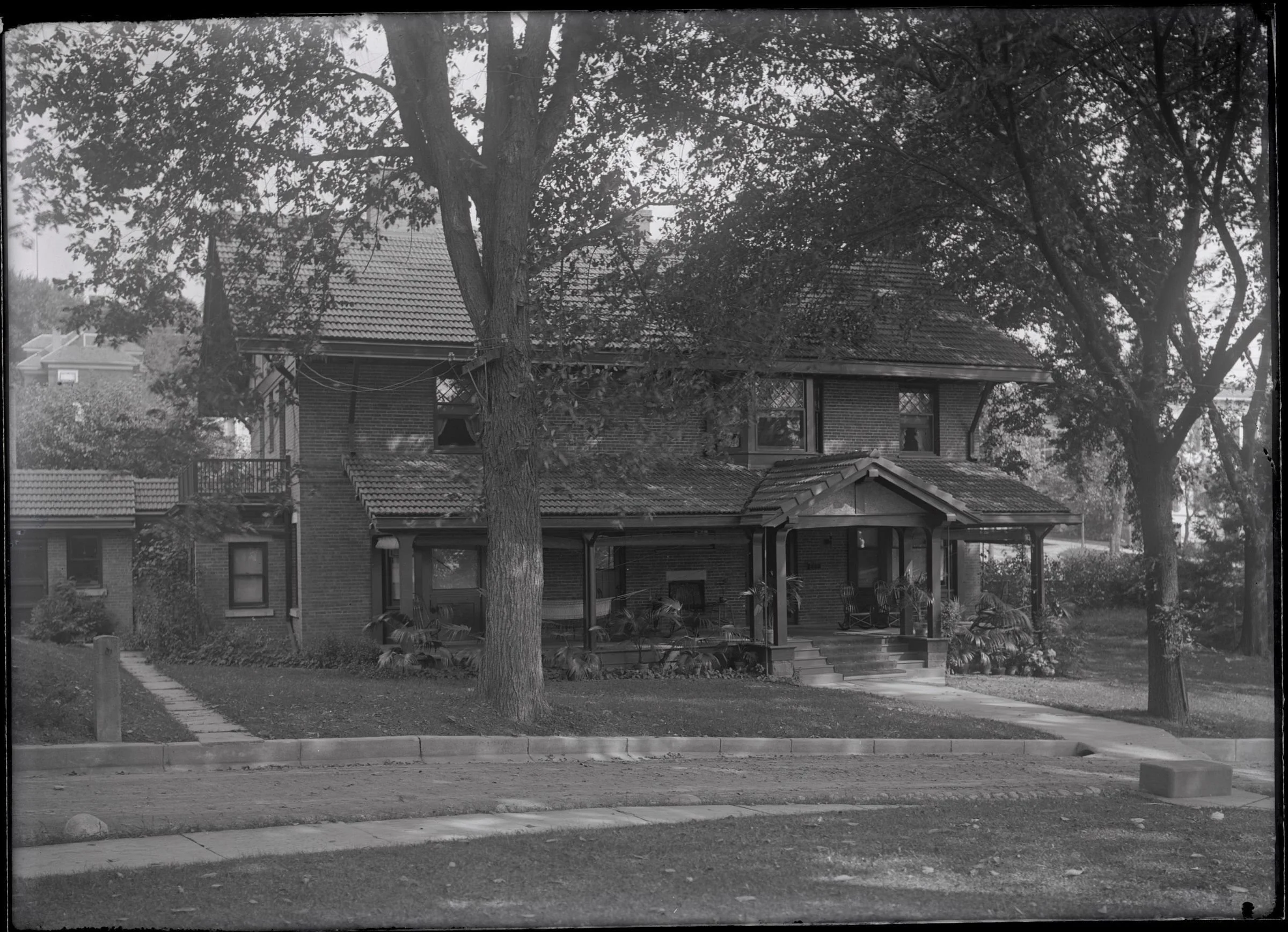
The 2.5-story Bailey home in Ithaca, co-designed by Bailey and Cornell architect Clarence A. “Pa” Martin, early 1900s. Not visible, to the left, are the greenhouse of Bailey’s design, the stable Bailey converted into an office, and the carriage house Bailey converted into an herbarium. Image courtesy of the Liberty Hyde Bailey Museum & Gardens, South Haven, Michigan.
“When President Theodore Roosevelt appointed Liberty Hyde Bailey to chair a national Commission on Country Life, he told Bailey that ‘the country life movement is the twin sister of the conservation movement,’ and this insight has never been more apt: the health of the planet cannot be disentangled from the health of rural communities. The model the Bailey Center puts forward—leveraging the reach and bipartisan trust of Cornell Cooperative Extension, with its agents stationed in every county of New York State—is an excellent model for breaking through geographical, political, and identitarian divides. If successful, we believe it could provide a model to be emulated and adapted by every land-grant university and state in the country.”
—Theodore Roosevelt IV
Project Team
Regional Advisory Board
Anna Bartel, Independent Consultant and Ecosystem Steward
Mary Jo Dudley, Director of Migrant Advocacy and Support (MAS), a project of the Center for Transformative Action
Melanie Forstrom, Executive Director, Cornell Cooperative Extension of Ulster County
Lauren Kruglinski, Development Director, Cornell Cooperative Extension of Ulster County
Kitty Liu, Editorial Director, Comstock Publishing, an imprint of Cornell University Press
Scott J. Peters, Professor and Director of Graduate Studies, Global Development Section, Ashley School of Global Development and the Environment, College of Agriculture and Life Sciences, Cornell University
Anu Rangarajan, Senior Extension Associate and Director, Cornell Small Farm Program, School of Integrative Plant Science, Horticulture Section, College of Agriculture and Life Sciences, Cornell University
Andy Turner, Associate Dean and Director, Cornell Cooperative Extension
Michelle E. Wright, Democracy Reform Advocate with Claim Democracy, a citizens’ technical assistance for civic literacy project; and Bookkeeper for the Child Development Council of Central New York
Staff
John Linstrom, Director of the Liberty Hyde Bailey Center Project for Cornell Cooperative Extension Tompkins County; Series Editor, The Liberty Hyde Bailey Library (Cornell University Press)
National Advisory Board
(Assembly of National Advisory Board now in process)
Wes Jackson, Co-Founder and former President, The Land Institute (Retired)
David W. Orr, Paul Sears Distinguished Professor of Environmental Studies and Politics Emeritus and former Counselor to the President, Oberlin College; Professor of Practice, Arizona State University
Sponsoring Agency
Cornell Cooperative Extension Tompkins County, an independent 501c3 nonprofit organization accepting donations on behalf of the Liberty Hyde Bailey Center Project
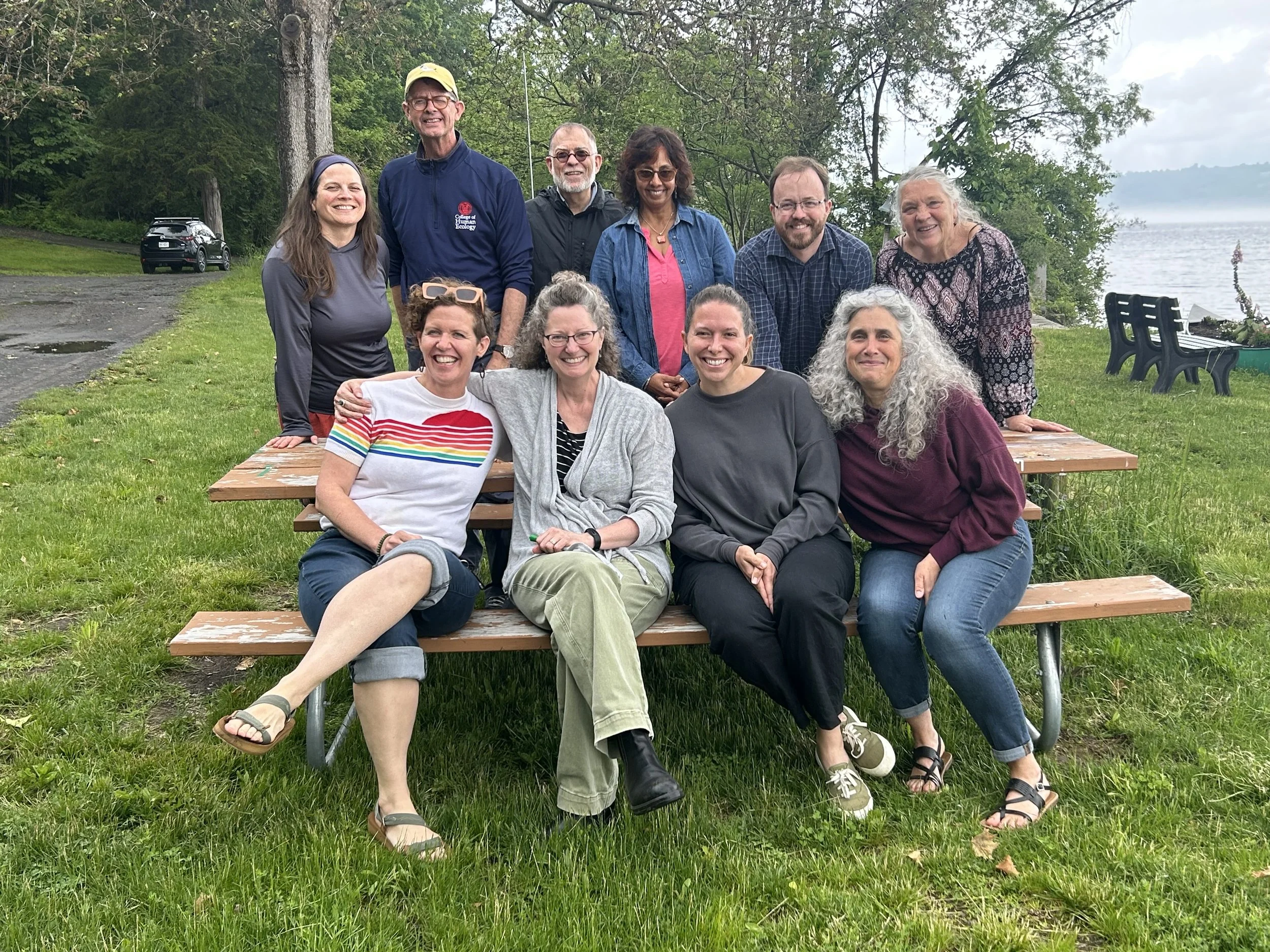
Advisory Board retreat at Girl Scouts Camp Comstock, June 2025
Contact us
Do you have questions about donating, or have ideas about who might like to support this project? Can you help in other ways? Have some general questions for us? Fill out this form and we will be in touch shortly. We can’t wait to hear from you!